Cyrus the Great: Founder of the Achaemenid Empire
Jan 23, 2025

Irani Bio
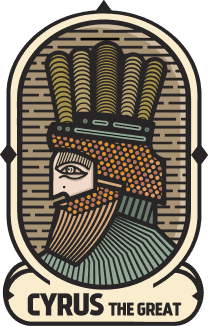
Cyrus the Great (Cyrus II)
The founder of the Achaemenid Empire; the King of the Four Corners of the World, the pioneer of human rights, and the visionary strategist who transformed a small Persian kingdom into the world's first global superpower.
Cyrus the Great: The Architect of World Order
Cyrus was not merely a conqueror; he was a revolutionary statesman. Rising from the vassal state of Anshan, he unified the Persian tribes and dismantled the Median hegemony. Unlike the Assyrian or Babylonian conquerors before him who ruled through terror, Cyrus established an imperial model based on integration, tolerance, and shared prosperity. His rise marked the end of the "Regional Age" and the beginning of the "Imperial Age," where diverse nations could coexist under a single, benevolent central authority.
The Unification of Iran and the Fall of Lydia
Cyrus’s military genius was first tested against his grandfather, Astyages of Media. By 550 BC, he had unified the Medes and Persians, creating a formidable military core. He then turned west to face Croesus of Lydia, the wealthiest king of his era. The fall of Sardis and the subsequent annexation of Ionia provided the Persian Empire with its first window to the Mediterranean world. This expansion was characterized by strategic speed and a surprising lack of retaliatory destruction, a hallmark of Cyrus's "Golden Rule."
The Liberation of Babylon and the Birth of Human Rights (539 BC)
The conquest of Babylon is perhaps the most significant event in ancient history. Cyrus entered the city not as a destroyer, but as a liberator. His "Cyrus Cylinder," often cited as the first charter of human rights, declared the freedom of worship and the end of forced labor. By releasing the Jewish captives and facilitating the reconstruction of the Temple in Jerusalem, Cyrus earned the title of "Messiah" and "Anointed of the Lord" in the Hebrew Bible—the only non-Jew to be so honored.
The Satrapy System: Innovations in Imperial Administration
While Darius I later refined it, Cyrus laid the foundations of the Satrapy system. He understood that a global empire could not be managed by a single ethnicity. He allowed local leaders to remain in power as Satraps (protectors of the province), provided they remained loyal to the crown. This "Dual-Authority" model ensured stability and reduced the likelihood of local rebellions, as the subjects felt their cultures and traditions were respected by the Great King.
Pasargadae: The First Expression of Persian Majesty
Cyrus chose Pasargadae as his capital, a site that reflected his personality—simple yet grand. The architecture here was a fusion of different styles (Median, Elamite, and Lydian), symbolizing the diversity of his empire. His tomb, a modest limestone structure that still stands today, remains a symbol of his humility and a sharp contrast to the extravagant mausoleums of later emperors. It served as a sacred site of pilgrimage for all subsequent Achaemenid kings.
The Gaps in the Record: The "Cyrus Legend" vs. Historical Fact
Cyrus is one of the few figures in history who is praised by his enemies. Herodotus, Xenophon, and the Babylonian chroniclers all depict him as a man of exceptional character. While modern historians caution against total hagiography, the consensus remains that Cyrus’s policies were uniquely humanitarian for the 6th century BC. His death in the east, fighting the Massagetae, left a vacuum that was only filled by his son's swift consolidation of power.
Legacy: The Father of Nations
The legacy of Cyrus the Great transcends the Achaemenid Dynasty. He influenced the founding fathers of the United States (Thomas Jefferson was a student of Xenophon's Cyropaedia) and provided the template for every subsequent empire, from the Romans to the British. He proved that an empire could be built on the foundations of respect rather than fear. To the Persians, he was "The Father"; to the Greeks, a "Lawgiver"; and to the Jews, a "Liberator."