Darius the Great: The Architect of the Achaemenid Empire
Feb 20, 2026

Irani Bio
Darius the Great
The Architect of Empire and the Pillar of Law
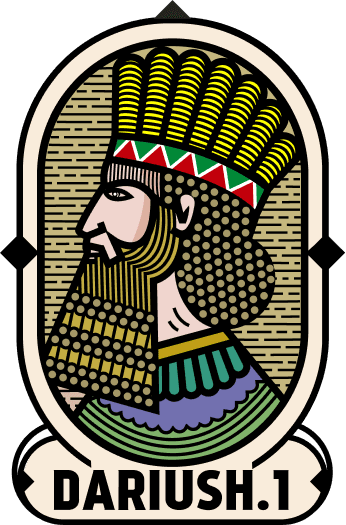
Darius I, known as Darius the Great, ascended the throne in 522 BC following a period of intense turmoil after the death of Cambyses II. A member of a lateral branch of the Achaemenid royal house and the son of Hystaspes, he managed to restore peace to the empire by suppressing nine major rebellions within a single year. Darius was far more than just a conqueror; he was a managerial genius who fundamentally reshaped .the political and economic structure of the ancient world for centuries to come
During his 36-year reign, the Achaemenid Empire reached its greatest territorial extent. From the construction of Persepolis and the Palace of Susa to the establishment of the first unified monetary system and transcontinental roads, every initiative reflected his long-term vision for governance. In the Behistun Inscription, Darius portrays himself as a ruler who, by the grace of Ahura Mazda, defeated "The Lie" and established justice across his lands.
Lineage and Rise to Power
Darius was the son of Hystaspes (Satrap of Parthia) and the grandson of Arsames. He rose to power after defeating the usurper Gaumata (who claimed to be Bardiya) with the support of six noble Persian families. .To solidify his legitimacy, he meticulously traced his lineage back to Achaemenes in his inscriptions
The Behistun Inscription and Rebellions
The first year of Darius's reign was dedicated to fighting claimants who revolted in Babylon, Elam, and other regions. His victories in these grueling battles were carved into the cliffs of Mount Behistun in three languages (Old Persian, Elamite, and Babylonian), remaining one of the most important historical .documents in the world
Administrative Reforms and the Satrapy System
Darius divided the empire into 20 to 30 large provinces called "Satrapies." For each, he appointed a governor (Satrap), a military commander, and a special inspector known as the "King’s Eye" to prevent .corruption and ensure that justice was served throughout the realm
The Royal Road: The First Communication Network
To facilitate the rapid movement of troops and messengers, Darius constructed the "Royal Road," stretching from Susa to Sardis (near the Aegean Sea). The road featured a sophisticated postal system with .relay stations (Chapar-khaneh), allowing messages to travel vast distances in record time
The Construction of Persepolis (Parsa)
Darius was the founder of the massive Persepolis complex. He intended it to be a symbolic capital, showcasing the unity of diverse nations under the empire's protection. Its architecture is an artistic blend of .Persian, Egyptian, Assyrian, and Greek styles
The Daric Coin and Economic Unity
Darius created the world's first unified monetary system by minting a gold coin called the "Daric" and a silver coin called the "Siglos." This innovation catalyzed trade across the empire's vast road networks and .simplified the collection of taxes and tributes
The Ancient Suez Canal
One of Darius's most astounding achievements was the completion of a canal connecting the Nile River to the Red Sea. A stele found in Egypt records his pride in this feat: "I ordered this canal to be dug... and ships ".sailed from Egypt to Persia
Achaemenid Law and Justice
Darius placed immense value on "The Law" (Data). He codified a set of legal principles designed to protect the weak from the strong. In his inscriptions, he frequently emphasizes his desire for fairness and the eradication of injustice throughout his territories
Military Campaigns and Borders
He expanded the borders of Persia from the Indus River in the east to Thrace in Europe to the west. His campaigns against the Scythians to the north and the early conflicts with the Greeks (such as the Battle of .Marathon) are among the most significant military events of his era
Religion and Tolerance
While Darius was a devout worshiper of Ahura Mazda, he followed the precedent of Cyrus the Great by respecting the faiths of all conquered peoples. He supported the rebuilding of the Jewish Temple in .Jerusalem and was recognized in Egypt as a patron of their local temples
The Immortals
He established an elite military unit consisting of exactly 10,000 soldiers known as "The Immortals." This force was the core of Achaemenid military might; whenever a soldier was killed or fell ill, he was .immediately replaced, ensuring the unit's strength remained constant
Death and Tomb at Naqsh-e Rostam
Darius passed away in 486 BC and was laid to rest in a tomb carved into the cliffs of Naqsh-e Rostam. His epitaph includes a profound testament to his character, expressing his lifelong wish for the security, peace, .and justice of Iran