Roxana: The Bactrian Princess Who Married Alexander the Great
Feb 01, 2026

Irani Bio
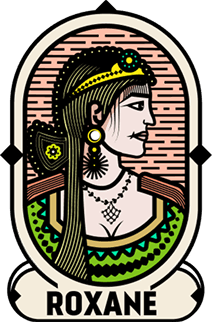
Roxana
The Princess at the Crossroads of Empires
Roxana was one of the most politically and historically significant women of the late Achaemenid period and early Hellenistic era. As the wife of Alexander the Great, she symbolized the political and cultural transformation that followed the collapse of the Achaemenid Empire. Her marriage to Alexander was not simply personal — it was a strategic act of imperial integration designed to stabilize newly conquered eastern territories.
Her life represents a turning point in ancient history, when Persian imperial traditions began merging with Macedonian and Greek political structures. Roxana became a living symbol of continuity during a period of global disruption and imperial restructuring.
Born in Strategic Bactria
Roxana was born in Bactria, one of the most strategically important regions of Central Asia. Bactria served as a commercial and cultural gateway between Persia, Central Asia, and the Indian subcontinent. As the daughter of a local nobleman, she represented the regional elite who maintained influence even during foreign conquest.
Her upbringing in this region gave her strong cultural and political value. Bactrian aristocracy played a key role in maintaining local stability during Alexander’s eastern campaigns.
Marriage as Imperial Strategy
Roxana’s marriage to Alexander was one of the most politically meaningful marriages of antiquity. Alexander adopted a policy of integrating local elites into his administration to secure loyalty across conquered territories. By marrying Roxana, he strengthened his political legitimacy in Central Asia.
This marriage also symbolized a broader imperial vision — the fusion of Greek and Persian worlds into a single political structure. Roxana became not only a royal consort but also a diplomatic instrument of empire-building.
Mother of the Imperial Heir
Roxana gave birth to Alexander IV of Macedon, the posthumous heir of Alexander the Great. After Alexander’s death, the birth of her son became a focal point of political power struggles among the Diadochi the generals who fought to control the fragmented empire.
Her role as mother of the legitimate heir gave her extraordinary political importance. In the ancient world, royal motherhood was often equivalent to political authority.
Political Struggles After Alexander’s Death
After Alexander’s death, Roxana became involved in intense political conflicts surrounding succession. The empire was divided among competing generals, and the survival of her son represented the continuation of Alexander’s dynastic line.
These conflicts highlight the importance of royal bloodlines in maintaining legitimacy during periods of political fragmentation. Roxana’s position made her both politically valuable and politically vulnerable.
Symbol of Cultural Fusion
Roxana represents one of the earliest examples of Greco-Persian cultural fusion. Her life reflects the meeting of eastern and western political traditions. The Hellenistic world that followed Alexander’s conquests was heavily influenced by this blending of cultures.
Through her, Persian aristocratic traditions interacted with Macedonian imperial governance, shaping the cultural landscape of the eastern Mediterranean.
Enduring Historical Importance
Although historical sources about Roxana are limited and often written from Greek perspectives, her importance remains undeniable. She stands as a symbol of imperial transition, dynastic struggle, and cultural synthesis.
Her story reflects the transformation of the ancient world from Persian imperial dominance to the multicultural Hellenistic era.